
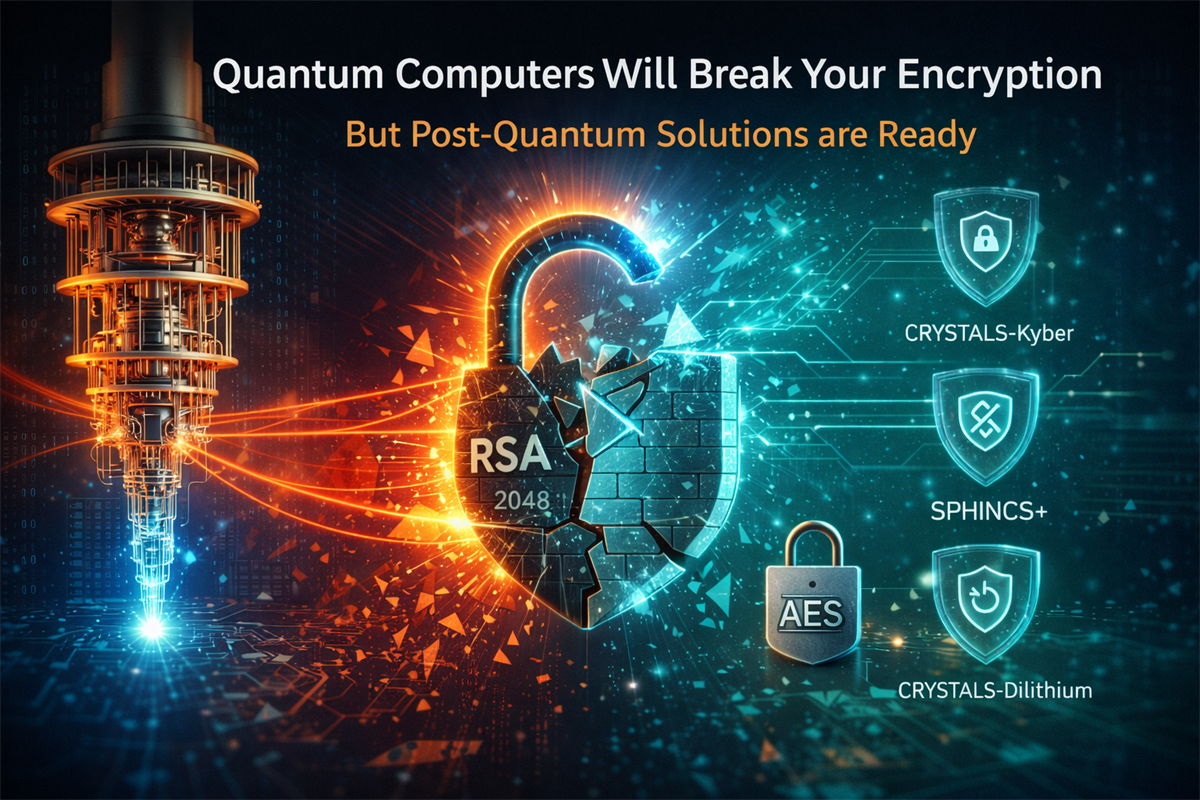
The Threat Model: Shor's vs. Grover's Algorithms
Public-key cryptography protects virtually every financial transaction, encrypted chat, software update signature, and TLS tunnel on Earth. Its security relies on the computational hardness of specific mathematical problems that classical computers cannot solve within human lifetimes: integer factorization (RSA) and discrete logarithms over finite fields and elliptic curves (DH, ECDH, ECDSA, Ed25519).
Quantum computing introduces physical systems that manipulate qubits exhibiting superposition and entanglement. Two distinct quantum algorithms fundamentally reshape the threat landscape:
- Shor's Algorithm (1994): A quantum algorithm that solves both integer factorization and the discrete logarithm problem in polynomial time: O((log N)^3). On a sufficiently scaled, fault-tolerant quantum computer with error correction (CRQC - Cryptanalytically Relevant Quantum Computer), RSA-2048, RSA-4096, and 256-bit elliptic curve keys can be broken in mere hours. Shor's algorithm completely destroys all classical asymmetric public-key infrastructure.
- Grover's Algorithm (1996): A quantum search algorithm providing a quadratic speedup for unstructured database searches: O(√N) operations instead of O(N). When applied to symmetric ciphers and hash functions, Grover's algorithm effectively halves the operational key length. An attacker attacking AES-128 requires 2^64 quantum operations (bordering practical feasibility), whereas AES-256 requires 2^128 operations. Because 2^128 remains beyond any conceivable physical computational limit, AES-256 remains completely quantum-resistant.
Quantum computers do not break all cryptography. They specifically eliminate classical public-key key exchange and digital signatures. Symmetric encryption (AES-256) and secure hashing (SHA-256, SHA-384, SHA3) remain secure, provided key lengths are sufficiently sized.
Harvest Now, Decrypt Later (HNDL) and Mosca's Theorem
A common fallacy in cybersecurity strategy is treating quantum decryption as a distant problem reserved for the mid-2030s. This ignores the reality of Harvest Now, Decrypt Later (HNDL), also known as retrospective decryption.
Nation-state threat actors, intelligence agencies, and advanced syndicates are actively tapping undersea fiber cables, compromised routers, and data center transit pipes today. They record vast archives of encrypted ciphertext streams: diplomatic cables, military communications, intellectual property, state secrets, and personal health identifiers. Even though they cannot read the ciphertext today, they will simply feed the captured sessions into a quantum processor the day one becomes operational.
Dr. Michele Mosca framed the timeline of cryptographic urgency with a simple inequality:
- X (Shelf-Life): How many years must your sensitive data remain confidential? (e.g., 25 years for medical or state records).
- Y (Migration Time): How many years will it take your organization to fully re-architect and deploy post-quantum systems across all infrastructure? (Typically 5 to 10 years).
- Z (Collapse Time): In how many years will a cryptanalytically relevant quantum computer emerge?
If X + Y > Z, your organization is already operating with compromised data integrity.
Vulnerability Breakdown: What Breaks and What Survives
Every security architect must distinguish which cryptographic building blocks in their stack require immediate replacement and which are safe:
| Cryptographic Primitive | Underlying Math Problem | Quantum Threat Status | Architectural Action Required |
|---|---|---|---|
| RSA (2048 / 4096) | Integer Factorization | BROKEN (Shor's Algorithm) | Replace with ML-KEM (encapsulation) or ML-DSA / SLH-DSA (signatures) |
| ECDH / X25519 | Elliptic Curve Discrete Log | BROKEN (Shor's Algorithm) | Migrate to hybrid X25519 + ML-KEM-768 for TLS session key exchange |
| ECDSA / Ed25519 | Elliptic Curve Discrete Log | BROKEN (Shor's Algorithm) | Transition code signing and root certificates to ML-DSA or SLH-DSA |
| AES-128 | Substitution-Permutation Network | WEAKENED (Grover: ~64-bit strength) | Upgrade all symmetric ciphers to AES-256 immediately |
| AES-256 | Substitution-Permutation Network | SECURE (Grover: 128-bit quantum strength) | Retain as primary symmetric encryption standard |
| SHA-256 / SHA-3 | Merkle-Damgard / Sponge Hash | SECURE (Collision: O(2^(n/3))) | Maintain SHA-256 or elevate to SHA-384 / SHA-512 for long-term safety |
Standardized NIST Post-Quantum Primitives (FIPS 203, 204, 205)
Following an eight-year global competition, the National Institute of Standards and Technology (NIST) finalized and published the world's first post-quantum cryptographic standards in August 2024. These algorithms rely on lattice-based mathematics and hash functions, mathematical problems for which quantum computers offer no known exponential speedup:
- FIPS 203: ML-KEM (Module-Lattice-Based Key-Encapsulation Mechanism): Derived from CRYSTALS-Kyber. This is the primary standard for general encryption and key exchange. It allows two parties to establish a shared symmetric secret over an untrusted network. It operates on the hardness of the Module Learning With Errors (M-LWE) problem in algebraic lattices. Offered in three security levels: ML-KEM-512 (NIST Category 1 - equivalent to AES-128), ML-KEM-768 (Category 3 - equivalent to AES-192), and ML-KEM-1024 (Category 5 - equivalent to AES-256).
- FIPS 204: ML-DSA (Module-Lattice-Based Digital Signature Algorithm): Derived from CRYSTALS-Dilithium. The primary standard for digital signatures, code signing, and identity verification. Provides fast verification times and moderate public key and signature sizes, operating on the Module Short Integer Solution (M-SIS) problem.
- FIPS 205: SLH-DSA (Stateless Hash-Based Digital Signature Algorithm): Derived from SPHINCS+. A conservative backup signature standard that does not rely on lattices. Its mathematical security depends solely on the pre-image and collision resistance of underlying cryptographic hash functions. While signature sizes are significantly larger (several kilobytes), it provides a crucial mathematical hedge in the event that unexpected breakthroughs occur in lattice cryptanalysis.
Hybrid Post-Quantum Key Exchange in TLS 1.3
Transitioning enterprise systems to pure post-quantum algorithms overnight carries operational risk: newly standardized algorithms might possess undiscovered implementation bugs or classical mathematical weaknesses.
The industry standard solution is hybrid key exchange (such as X25519MLKEM768). In a hybrid
handshake, the client and server execute both a classical elliptic curve key exchange (X25519) and a post-quantum
key encapsulation (ML-KEM-768) simultaneously. The resulting shared secrets are fed into a Key Derivation Function (KDF)
to produce the final session key:
To decrypt a hybrid session, an adversary must break both the classical algorithm AND the post-quantum primitive. If ML-KEM-768 were somehow compromised tomorrow by a mathematical breakthrough, classical X25519 still protects the traffic against classical eavesdroppers. If a quantum computer arrives, ML-KEM-768 prevents the quantum decryption.
Google Chrome, Cloudflare, and major operating systems have already enabled X25519MLKEM768 by default for
HTTPS connections, securing billions of daily web sessions against HNDL attacks without detectable user latency.
Hands-On Verification: Inspecting Post-Quantum Handshakes
Engineers can inspect and test hybrid post-quantum TLS handshakes using modern OpenSSL 3.3+, BoringSSL, or the Open Quantum Safe (OQS) toolkit. The following command sequence illustrates how to verify whether your endpoints negotiate post-quantum key encapsulation:
# 1. Connect to an endpoint requesting the hybrid X25519 + ML-KEM-768 key exchange group
openssl s_client -connect cloudflare.com:443 -curves x25519_kyber768 -tls1_3 < /dev/null 2>&1 | grep -E "Peer signing digest|Server Temp Key|Negotiated Group"

# 2. Inspect curl negotiation with verbose TLS handshake telemetry
curl -Iv --curves x25519_kyber768 https://cloudflare.com 2>&1 | grep -i "SSL connection using"

# 3. Generate an ML-DSA-65 (CRYSTALS-Dilithium) post-quantum private and public key pair (via oqs-openssl)
openssl genpkey -algorithm mldsa65 -out mldsa65_private.key
openssl pkey -in mldsa65_private.key -pubout -out mldsa65_public.key

# 4. Sign a critical firmware payload using the post-quantum signature
openssl dgst -sign mldsa65_private.key -out firmware_manifest.sig firmware_payload.bin

# 5. Verify the signature against the post-quantum public key
openssl dgst -verify mldsa65_public.key -signature firmware_manifest.sig firmware_payload.bin
Tactical Matrix: Classical vs. Post-Quantum Cryptography
When migrating systems, engineers must understand the performance trade-offs. Post-quantum public keys and signatures are larger than classical 256-bit elliptic curves, requiring adjustments to MTU sizes and packet buffers:
| Algorithm | Type | Standard | Public Key Size | Ciphertext / Signature Size | Security Level |
|---|---|---|---|---|---|
| X25519 (Classical) | Key Exchange | RFC 7748 | 32 bytes | 32 bytes | Classical 128-bit (0-bit Quantum) |
| ML-KEM-768 | Key Encapsulation | FIPS 203 | 1,184 bytes | 1,088 bytes | NIST Level 3 (~AES-192) |
| ML-KEM-1024 | Key Encapsulation | FIPS 203 | 1,568 bytes | 1,568 bytes | NIST Level 5 (~AES-256) |
| Ed25519 (Classical) | Digital Signature | RFC 8032 | 32 bytes | 64 bytes | Classical 128-bit (0-bit Quantum) |
| ML-DSA-65 | Digital Signature | FIPS 204 | 1,952 bytes | 3,309 bytes | NIST Level 3 (~AES-192) |
| SLH-DSA-SHA2-128s | Stateless Hash Signature | FIPS 205 | 32 bytes | 7,856 bytes | NIST Level 1 (~AES-128) |
Enterprise Cryptographic Agility Migration Blueprint
Replacing cryptography embedded across databases, microservices, hardware security modules (HSMs), and client devices cannot be accomplished overnight. Organizations should follow this 4-phase transition blueprint:
- Phase 1: Cryptographic Inventory (CBOM): Build a comprehensive Cryptographic Bill of Materials. Scan source repositories, certificate authorities, VPN concentrators, and database encryption engines to discover every point where RSA or ECC keys are generated or stored.
- Phase 2: Cryptographic Agility Architecture: Refactor codebases so that cryptographic algorithms are abstracted behind standard interfaces rather than hard-coded into application logic. If an algorithm must be swapped, it should require a configuration update rather than an entire application rewrite.
- Phase 3: Deploy Hybrid Protocols: Enable hybrid key exchange (X25519MLKEM768) on edge load balancers, reverse proxies, and VPN tunnels. This neutralizes Harvest Now Decrypt Later attacks immediately without breaking legacy clients.
- Phase 4: PKI and Firmware Transition: Update internal Certificate Authorities, root certificates, and code-signing pipelines to support ML-DSA or stateful hash signatures. Ensure all hardware security modules (HSMs) support firmware upgrades for post-quantum primitives.
Post-Quantum Operational Readiness Checklist
Evaluate your organization's resilience against the coming post-quantum transition with this checklist:
- Symmetric encryption standards upgraded to AES-256 across all data-at-rest stores.
- Cryptographic Bill of Materials (CBOM) established to identify all legacy RSA/ECC dependencies.
- Long-lived sensitive data stores identified and audited against Mosca's Theorem (X + Y > Z).
- Hybrid post-quantum key exchange (X25519MLKEM768) enabled on ingress proxies and web servers.
- Network MTU buffers verified to handle larger post-quantum TLS ClientHello and signature packets.
- Hardware Security Module (HSM) vendor roadmap audited for FIPS 203 and FIPS 204 support.
- Software code signing keys scheduled for migration to post-quantum signature algorithms.
Post-quantum cryptography represents the most significant architectural migration in Internet history. By adopting hybrid encapsulation today, organizations effectively immunize their traffic against future quantum breakthroughs.
Operational Scope: Published exclusively for cryptographic transition planning, network protocol hardening, and cryptographic agility architecture.